
Interview
Ioanna Demertzidou: The world is not habitable, you have to admit that.
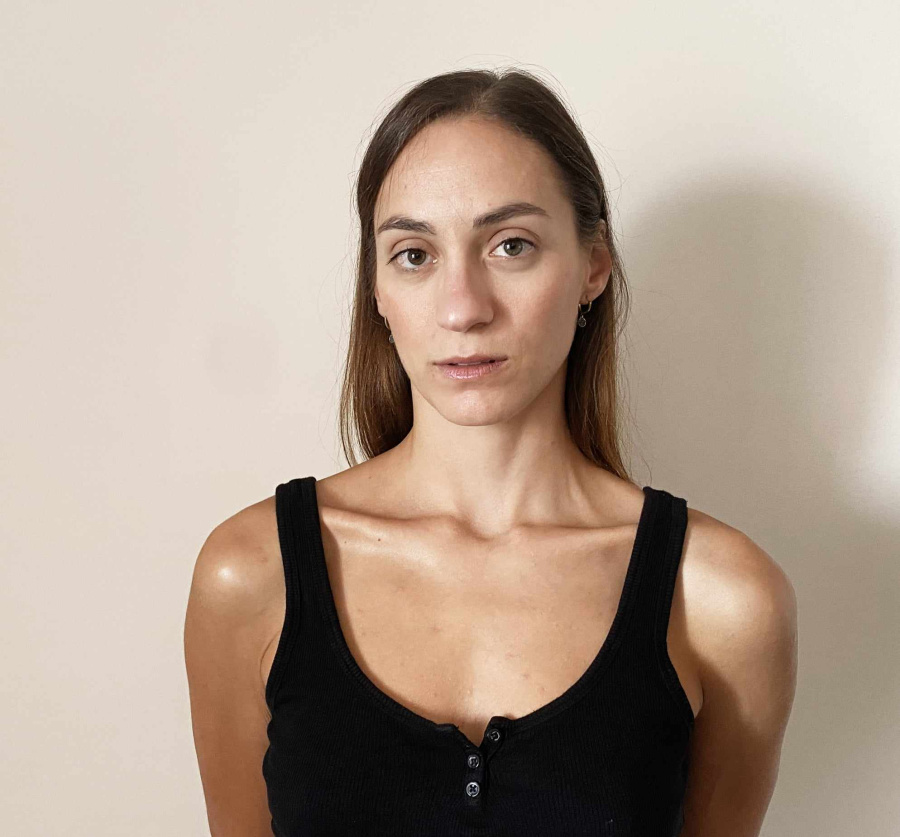
The phrase that entered the title is the phrase that characterizes Ioanna Demertzidou, who is currently playing Brecht's heroine St. Té in his always topical play "The Good Man of Szechwan". I talked to her about her approach to the play, her collaboration with Dimitris Karantzas, the similarities we find in relation to the reality we live in, and she did not fail to emphasize that she has no illusions of hope in our society..
Would you like to tell me a little bit about the rehearsal period?
What was it that attracted you to your heroine St. Te?
Her journey is proof that humans are not one-dimensional beings. There are so many contrasts in our character. We are multifaceted and complex. Capable of everything. Circumstances, whether external or internal, activate and illuminate our different qualities. Shen Te represents for me the great instinct of survival. What are the ultimate limits a human being can reach to survive? How much will he be altered, and in the end will he really survive?
How is the collaboration-acquaintance with Dimitri Karantzas?
Dimitris Karantzas is a rare artist! His dedication, his love for theatre, his tenacity, his goals are touching and inspiring indeed. I trusted him and he trusted me throughout the difficult and creative rehearsal process. I am deeply grateful that life brought me this gift meeting not only on a professional but also on a personal level.
How difficult do you think it is to remain ethical in the times we live in?
"There are still good people, despite so much misery. Wickedness is nothing but a kind of clumsiness," Shen Te tells Sun. If we know ourselves and have a solid foundation, I believe we can keep our morals and values. It takes constant effort and work. Consciousness, strength and determination to recognize and hold up our sense of rightness.
Would you describe it as a hopeful work towards human liberation?
It would be hopeful if we all really asked ourselves how this world could be changed and if we realized that the starting point is ourselves. If we did not constantly shift the responsibility to someone else, if we were ready to get out of our own way, to listen and be heard.
Brecht leaves the viewer to draw their own conclusions on whether the heroine can live differently?
Surely he wants to awaken his own judgment. The question is often more important than the answer.
Do you think capitalism has covered up all of man's ideological beliefs?
I think that, as the words imply, you either have "capital" at your center, or your ideology and your morality! Capitalism, where it could have been an offshoot of the economic and political structure of humanity, has suddenly become the whole forest. "Art has become money and money has become art," wrote a favorite band of mine 20 years ago. And unfortunately "the art of money" in Greece is swallowing up any other art form. When you have nothing to eat, when your house, your dignity is taken away, and you are fighting for your survival, you don't have time to fight for your ideals.
Do you see in the play events that have recently happened in our country?
Let's not go far..and in our city! It's only been a few weeks since the homophobic attack in the middle of Aristotelous Square. It's only been a few days since a young girl was murdered in cold blood in front of a police station at the moment she was begging for help. Brecht articulates it better than I can: "They do violence to your brother and you turn a blind eye? He screams loudly and you keep quiet? What kind of town is this? And what kind of people are you? When something unjust happens in a town, it has to be done! And where it can't, then it's better for the city to sink, to burn before the night is dark." .
Do you feel optimistic about the future?
I still maintain faith and hope, as much as my romanticism allows me, sometimes easier and sometimes harder. I still believe in people. However, I have no illusions about the society we live in. And this is exactly where the next question is connected.
What phrase from the play characterizes you and do you find common features with St. Te?
"The world is not habitable, you have to admit it" ...