
Interview
Maria Skoula: I have seen many women step forward as airbags or mounds to prevent conflicts at home.
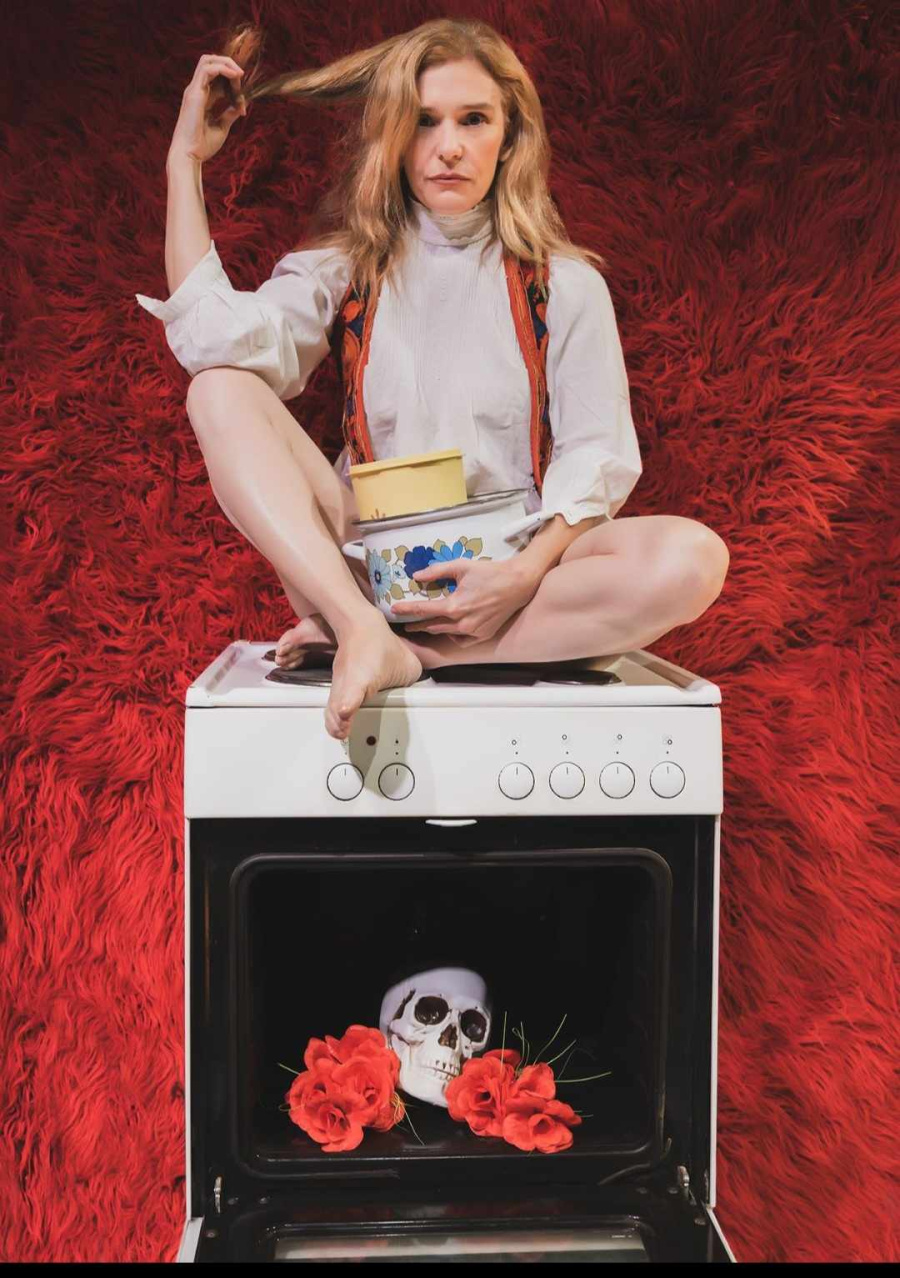
Maria Skoula is currently co-starring with Maria Maganari and Amalia Kavali in the adaptation of the book "My Husband" by Rumena Buzarofka, directed by M. Maganari at the Thiseion Theatre. I met with her in Exarchia for a coffee and we talked about the play and the women we will see in the performance...women who are afraid and try to shake off this fear and talk about everything that troubles them, looking at the future with more courage and boldness.
How was the premiere, a few words about your beginning?
The author was with us at the premiere and that was nice. I was curious how she would see it. I felt a sense of calm and joy at sharing this text that has travelled everywhere and I felt the stage and the square becoming more united that day. I remember there was a positive aura, no anxiety as if everything was in place and we were communicating harmoniously with the audience.
Are the women we see in the show women next door?
The feeling I get after all this work is that every woman is not one. Most of the women we've chosen have in common that they don't work, they're in the house and the men are the ones who work. Each of them is not one woman, while they are complete persons it is as if they are made up of many women. During the course of the action, the narrative, they become something else because circumstances lead them to do things they would not otherwise do. There are women who externalize what they feel and those who are silent and keep it after them. In the stories I tell the common denominator is fear and at some point through what they have to deal with they are led to realize that they shouldn't be afraid.
Even the seemingly "holy" family balances between lies and truth?
It was a necessity created in previous centuries and especially in the 20th through the hardships they went through and there had to be a strong core to endure. But now there are other ways to keep the balance and overcome the difficulties. And this is what both women and men have done, each from a different starting point. But it is the woman who is forced to keep the balance. I have seen many women step forward as airbags or mounds to avoid conflict at home. There has always been a fear of anything, and when you are afraid you can't be honest. I think younger generations are more vocal than older generations.
Is there a "fallacy" as far as women's liberation is concerned?
Many things have changed but there is still a long way to go before this change takes root in us. We are also moving in places that are towards change more clearly. But when I move away from these areas I am shocked by the way they speak and behave. Even in the simplest conversation between men about a woman. If we don't get that sexism out of even the words we use in our daily lives then nothing is going to change. There is still a way to go, but I see women around me who are speaking up and speaking out, each in their own way.
Do you think the Greek family straddles the line between east and west?
I think it is something very much our own. Neither eastern nor western. Everything we talk about is so deeply rooted in us that it is not easy to get rid of it. We are making attempts to move towards another area that is freer and that takes effort.
Is the silence of many women a sign of familiarity with cruelty?
No, this is not common. Perhaps we think it is the only solution when we are forced to be dependent. This silence is a situation that you don't think will be forever. You can never fully accept it. This silence is not calm. On the contrary, it says a lot. But you don't open your mouth to let them out. And you betray yourself through this silence. At the same time there is the receptivity of your surroundings that you will undergo, you put aside what you feel and thus, slowly without realizing how it happened, you cease to be free.
Do all these stories we will see illustrate a failed equal rights society?
What I would like is for us to mirror ourselves against these stories and acknowledge something. That we see something of our own and once we see it, we can change something. These texts expose the female soul right before the moment she realizes that she has to maneuver to exist and that's what she wants to end. There can be no other way even if it is conflict. I am very happy to convey these stories and in this way as chosen and guided by Maria Maganari and I am even happier when the show starts and we meet there on the stage of the theatre with Amalia Kavali and Maria Maganari ready for a new encounter of the audience with these seven fascinating female figures.