
Giorgos Tatakis talks about his new collaboration in the film "The Slayer"
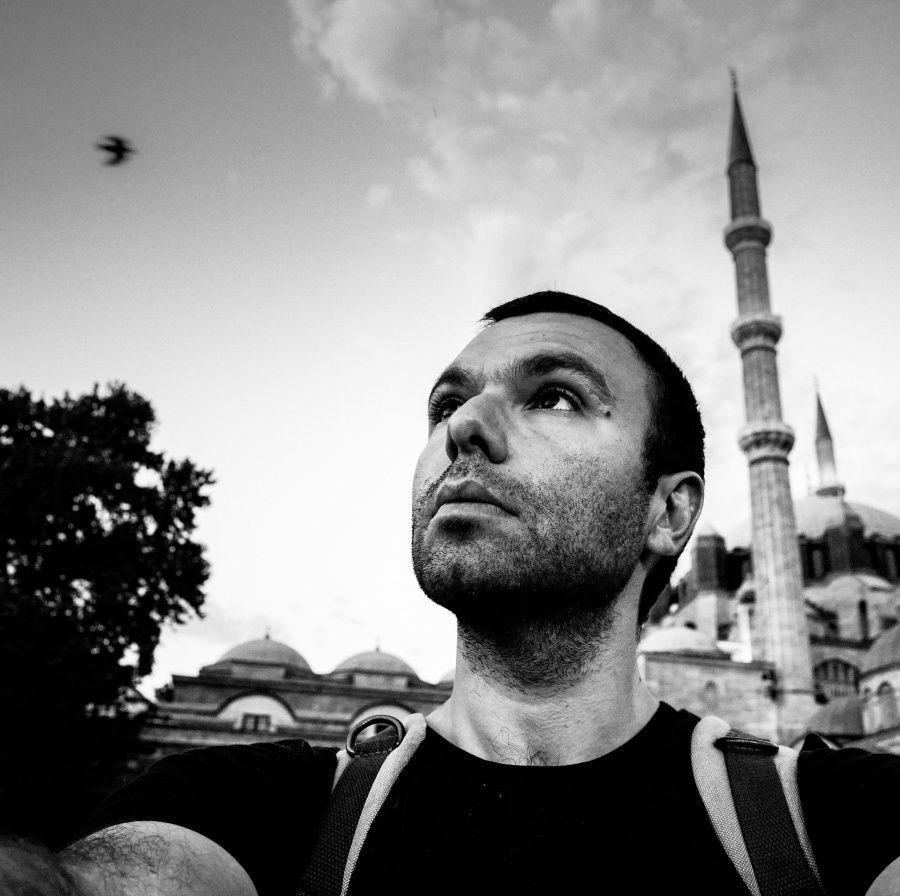
Giorgos Tatakis, the photographer behind Papadiamantis' upcoming film "The Slayer" directed by Eva Nathena, talks to me about the collaboration they had, his memories from when he read the book and how it inspires him to do new things, its timeliness and the fact that the next job always leaves you with the best memories.
How did the collaboration come about so you could be in the production of The Slayer?
It was by chance that the collaboration came about. They contacted me, saw my work and liked what I was doing. They matched my style with what Eva had in mind for the film. What the conditions would look like where the film would be shot and also aesthetically. For me it was a first for me, I had never done anything like it before. I never cared about shooting the official backstage of a film, but because they described the film to me it suited me because it was close to what I do.
What are your own memories of reading the book?
It's one of my favourite literary books and I really like Papadiamante. I also recently read a collection of his short stories called the Athenian Tales. I think Papadiamantis has a way of storytelling that, for me at least, inspires me to do new things. He creates such vivid images in the narrative that I want to create something.
Is it still a topical book?
Yes it definitely remains, not directly obviously but it has a pairing with today in the sense that from one moment to the next someone or someone can do something bad like the heroine of the play, but also the part about feeling cut off from a larger community because you think differently and that alone can be a reason for a whole system or community to come after you.
How would you characterize Hadoula?
If we were to characterize her somehow we would say she was oppressed. By the family, by the community, by the residents. She is a victim of a situation that in her trial perception she feels she could not escape from, perhaps because of the time. She was a victim of an indirect oppression.
What is it that you wanted to capture as a photographer?
I was interested in the photography part. I was interested in my result standing up photographically and at the same time being consistent with my own psyche. My photographs always talk about something other than what you see at first sight, but in general I don't want to talk about what the object is I want the viewer to think about it alone and I even think that the right result for a photograph is that if 20 people see it there are 20 different opinions.
Why does black and white dominate in your photographs?
First of all the easy answer is because I like it. But if you go back further when I was a kid what I fantasized about if I ever became a photographer and did exhibitions I thought those would be black and white because in my mind the photo on display was black and white. The second part is that I'm quite interested in geometries and forms in a composition and generally those two qualities are best seen and emphasized in black and white. Finally with painting as long as I have been involved I have always liked drawing more.
If you were to take your last picture what would it be?
I can't answer that because every day I have different ones. I have no desire to photograph anything in that sense I say that. Because it's not the center the faces I collect photographically it's more my ideas that are photographed.
Of all the jobs you've done, which one has left you with the fondest memories?
The next one is always the answer.