
Alexia Kaltsiki talks about the Bacchae: Everything happens in a storm and absolutely, irrevocably.
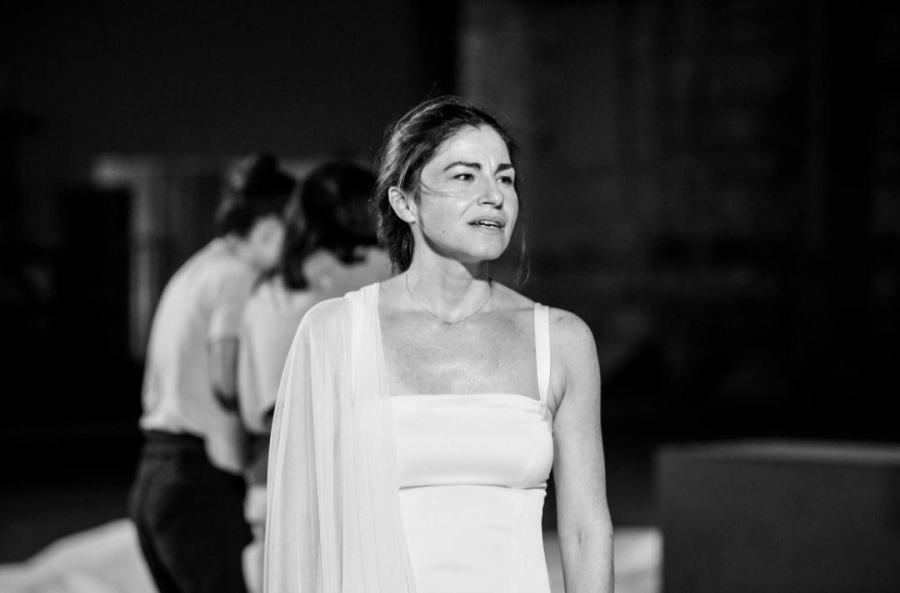
This summer Alexia Kaltsiki plays Agave in Euripides' tragedy "Bacchae", directed by Thanos Papakonstantinou. I met her and she spoke to me about the particularities of this play, commented on the conflict between Pentheus and Dionysus and did not fail to mention the constant dialogue between Agave and Chorus, something that differentiates this tragedy from the rest.
Would you like to comment on the conflict between Pentheus and Dionysus?
- Schematically, one could say that we have in Pentheus the legal order, materialism, and on the other hand Dionysus who reminds us that there is another part which the mind and thought cannot control. That he cannot deny its animal origin. In fact, Dionysus illuminates the darknesses of Pentheus the dark and horseless landscapes of human nature. The conflict between these two characters is not conducted in monologues as in most tragedies. Here the conflict of the main characters is done in rhyme and their action is a process of transformation.
Tell me about Pentheus' hubris towards Dionysus.
- Pentheus denies the divine. He even considers the religious institution of the city necessary only for the functioning of the state, not because he believes in the divine. He is theomachic. He struggles with what he does not see and does not understand.
Is there in the play a repression of instincts and a voyeuristic gaze that characterizes Pentheus?
-Pentheus fantasizes about orgies when he talks about the Maenads, the women of Thebes who ascend the mountain at lightning speed but are not initiated like the Asian Bacchae, faithful followers of Dionysus. But the narratives of the angels convey images that far exceed his fantasies. But the nuclear issue at stake is the gap between knowing and being known. Pentheus wants to see-to-know but does not want to know.
Would you like to talk about the role you play as Agave?
- Agave is in constant dialogue with Chorus, with Cadmus and with Dionysus. It's like the whole thing is built out of this give and take. The surviving text of the exodus is fragmentary. Her lament and the first part of Dionysus' monologue announcing her future are missing. Chimonas has chosen passages from Christ Passion for Agave's lament . Then unlike other works the powerful circumstances of the plot appear condensed at the end. It is very difficult material. Everything becomes stormy and absolute, irrevocable. For example, after the appearance of Dionysus and their exile, the theme of the dismemberment of Pentheus does not recur. It reminds me of the function of dreams.
Are there any particularities in Euripides' particular tragedy?
- He didn't write it in Athens but in Macedonia when he was an old man. It's interesting how he handles the theme of old age in the play. From the beginning I was terribly impressed that a sire has surrendered power before his death and that is Cadmus. The most enigmatic yet important figure in the tragedy . He founded this city and is the only one who has a metaphysical future. He transforms into a dragon. Many times in rehearsals I think we're just a bad seed of his. Cadmus, according to Dionysus, will sow new cities. Finally, another important circumstance is that it was set after Euripides' death in an Athens fragmented by the Peloponnesian War.