
Interview
Yannis Niarros: I wanted to do something that I wouldn't care if I was good at performing or if the performance would make sense.
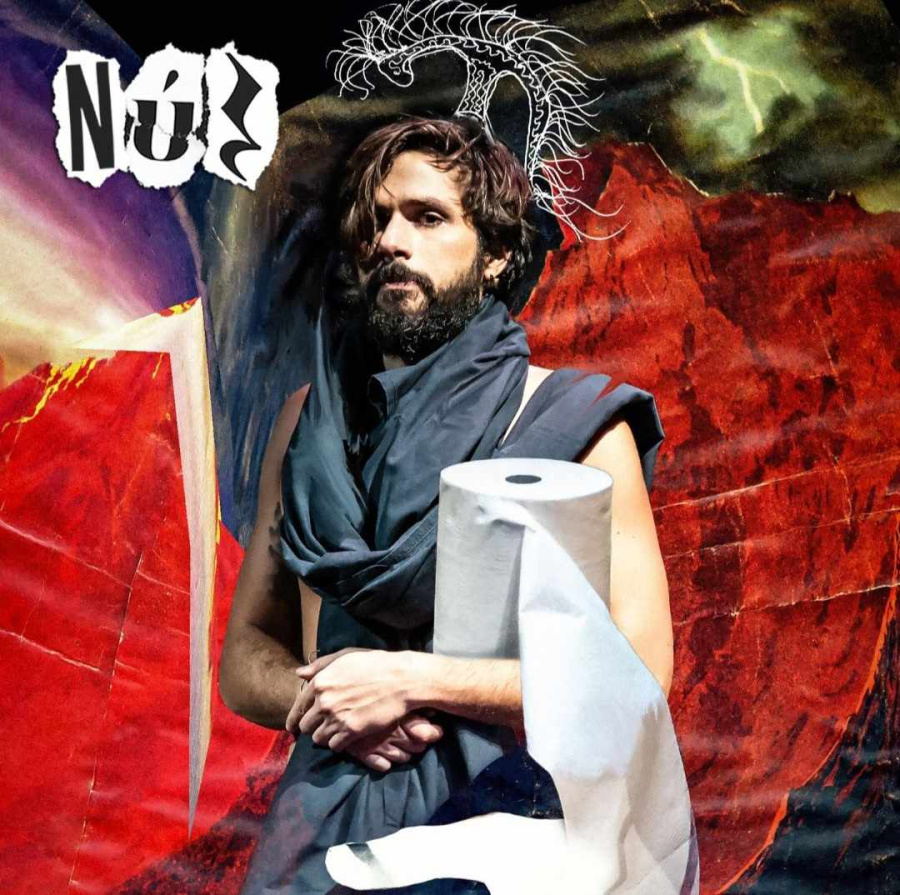
Yannis Niarros takes me to the surreal world of Panos Koutroubousis and Julio Cortasar, at the same time he talks to me about the collaboration he has with his dear friends, the music and the decisive role he plays in the performance, while he also mentioned the personal element that governs the play.
Would you like to introduce us to "Nyx, Los History Oddities" and what inspired you to do this show?
Weird stories are usually made up at night and also during the day in our heads which means that their source is the unconscious and not the conscious, not the conscious mind but the unconscious. Which in my mind is all these micro-information, all these micro-elements that the brain puts together, it can be a smell, a look, a piece of information, a number, whatever, but they all make up a single story together. I was inspired to do this performance by the fact that I love Yannis Papadopoulos, Dimitris Klonis, Hara Mata Giannatou, George Mizithra and Vassilis Malamas. All of them are friends of mine who I always wanted to work with and that combined with the fact that I didn't want to do a performance project, I started thinking about what I could do with them and that was storytelling after music. So it slowly came about.
What's so special about these stories we're going to see and hear?
Nothing special on a universal level. But on a personal level they are very much my favorite stories and certainly one of their specialness for me is that they are theatrical. It's nice to play them in the theatre.
How is Panos Koutroubousis connected to Julio Cortasar?
What connects them is surrealism. It is the eye that is shaken under the influence of drugs, under the influence of eternal childishness and spirituality at the same time. A combination they both have in their writing. A well-meaning nobility more Panos Koutroubousis and a childlike nostalgia and poeticism Julio.
What is the role of music in the show?
The role of music in the show is like an actor might have a role. That is, sometimes it is a conversationalist, sometimes it is the one who is the obstacle of the scene or the story and we have tried to perceive it as a member of the troupe. We started rehearsing together, we started choosing the texts together, the kids from the musical side suggested and it was a huge part of both the creative and practical execution. It's a peculiarity of the show that it has a lot of music during the show. Also another nice thing is that the children are also actors within the show which few musicians can do to the extent that the children achieve and that's one reason why I wanted to work with them. Because they're not narrow-minded enough to say that since we're musicians we can't perform in the theatre or vice versa. Clearly there is a clear distinction between the two but you can't be a good musician and not understand theatre even a little bit and conversely you can't be good at theatre and not understand music practically speaking and not on a knowledge level. I mean as a feeling, as an instinct. You can't do theatre and not understand rhythm or not understand melody or orchestration.
Does this particular project feel very personal to you?
It feels quite personal because it's also a coincidence that I didn't want to do theatre but something more loving that doesn't rely on the classic play-director-actors formula. I wanted to do something where I didn't care if I was good at performing or if the show would get any meaning across. So I came up with a list of a lot of issues that I care about with dreaming and surrealism as a language as the main focus. Without meaning to in the end something has been created that is so personal that it does concern many people because the collective unconscious is a really powerful thing. I think we all think that our neighbour is living something different from ours but I feel that if I could give a number or do a calculation 8 out of 10 of us are going through the same things, we think about the same things in a different way maybe but our problems are the same. Whether they are funny, ridiculous or serious.
Do modern people lack this surrealism that one sees in Koutroubousis' works?
I think it is not missing because we experience it every day. If you go on instagram you will see it in videos that are there. A surrealism that Koutroubousis in the 60's and 70's when he was painting comics couldn't have imagined that it would be a reality, and it is. The sci-fi of the 70s and 80s is now outdated, so now our relationship with surrealism has become more different. I think there are fewer surreal things in our time than there were in the days of Pan and Cortasar unfortunately, but also fortunately because we have to come up with new forms to reinterpret something that is surreal.
Have we become shallow in our dreams-are we struggling with something easy?
No I don't believe that and I don't think it's collective. Every person feels something different. Dreams become shallow when they come true when they become reality. Then it stops being dreamy, it stops being so beautiful so I think whatever remains unfulfilled is there to keep us moving, to keep us going. Like happiness is a dream.
How did you handle the success of the Spitbox and the Players?
With great joy. It has motivated me to keep going and I feel very lucky to be able to do whatever comes into my head with tremendous support, love and anticipation.