
Interview
Evi Koutalianou: Yes, the romance is gone and its place is taken by anxiety, fear, insecurity and sadness.
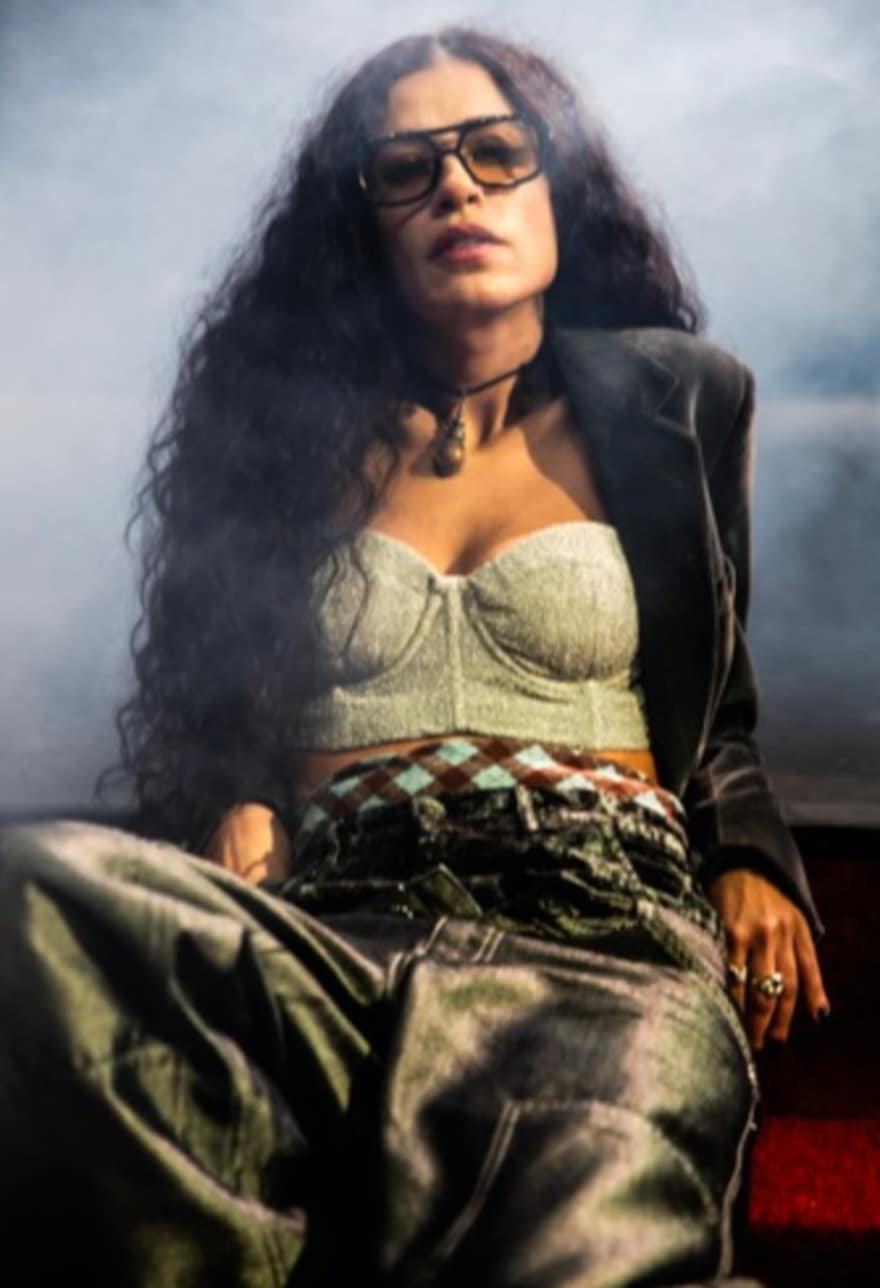
Evi Koutalianou is currently participating in the performance "Shakespeare's Romeo and Juliet" directed by Konstantinos Rigos at the Theatre of the Company of Macedonian Studies. I met her and she spoke to me about the importance of the play, the emotional connection she has with it, the romance that is missing nowadays and finally how happy she feels to be working with Konstantinos Rigos.
How do you perceive this timeless work?
"Romeo and Juliet" is a very personal affair for me as I am emotionally attached to this play. You see, it was the occasion a few years ago to meet the most important man in my life, whom I fell madly and completely surrealistically in love with. To this day I consider it to be the greatest love I have ever experienced. So, this play is inextricably linked to him, and that's why in many of our rehearsals I was strained, which still happens to me during performances. For me, this play is a revolutionary act at any cost and of course, this act could not be other than love at first sight. That's the only way I can understand it. A great love without conditions or limits.
What do Romeo and Juliet represent?
They represent the only tool we humans need to love and fall in love, and that is clearly courage. To first of all accept what happens to you, to be unable to exist without the other person, to be able to kill or be killed for the person you know and feel is your other half, takes great courage. Love is a revolution, and to start any revolution all it takes is to arm ourselves with all our courage - those of us who have it, of course. Romeo and Juliet are two teenagers who go against society, against their families, against the pettiness of people and show us that unconditional love and love have no barriers, cannot be defeated by human parameters and they die because, quite simply, they cannot go on living in a world without each other.
Would you describe them as two "rebels" against the ugliness of the world?
Of course, as I mentioned above, love is the one revolutionary act and our two heroes put it forward in a very poetic way in the play, using it as an escape from a universe of hatred and as a refusal to join a society immersed in darkness. Their love is portrayed as a powerful educative force that transcends all social conventions and the conflict their families have with each other. Although born into a world that has been eroded, he manages to overcome social and family ties at all costs. They react to an action. They fight for their love and prove that when you fall in love, nothing can stand in your way, not even death itself.
Would you like to talk to me about the contrasts in the play, light-dark, love-hate?
The play is full of such contrasts. We have the birth of love in a time of heartbreak. At the same time, when a rotten society is throwing parties to cover its darkness, the love of the two brings out the real light. An inexplicable rivalry between two capitalist families in Verona ends the moment their children decide to die for love. Throughout time, children are the world's only hope for a better tomorrow. They will bring change and break the status quo. As P. Sidiropoulos says "Defend the child, for if the child is spared there is hope". So the tragic love story of these two children actually serves as a cautionary tale about the devastating consequences of hatred and social divisions. Either way, the answer to hate is always love.
Tell me about your collaboration with Konstantinos Rigos.
Working with Konstantinos has been a lifelong dream since 2009 (if I'm not mistaken) when he staged "Titanic" at Piraeus. I remember myself being bone-headed that night with what was happening on stage and to this day I remember a big chunk of a particular monologue from the show. So, I am deeply grateful to be part of this year's Romeo and Juliet. Constantine is an artist, a very great creator full of passion, which he conveys to you during the collaboration with great ease. Intelligent, charismatic and with a clear vision. He knew from the very first rehearsal what he wanted to do and guided us very methodically as to what he had in mind. He is a sweet man, gentle - which is rare in our business, but more importantly - with an incredible sense of humour and always ready to go. He treated us all with great respect, absolute composure and love. It is a great gift for me to have this particular collaboration and I think this is true for the whole company.
In this day and age, how much have technology and the digital world affected people's relationships?
I'll answer with a story told to me years ago by the dad of a very dear loved one who was upset that one afternoon he walked into the house and saw all of us with our cell phones having become the extension of our hand. When he was about 25 he was walking down Patision and saw a girl who caught his eye. Before he could approach her to talk to her, the girl got on a bus and then Mr. S, started running behind the bus as fast as he could to the next stop, where he managed to get on the bus to meet the girl he fell in love with at first sight that afternoon. Not only did he meet her, he married her! Today that's not going to happen. I feel that nowadays technology and the digital world have killed off spontaneity, the impulse of the moment and our emotional world in us to a very large extent, making things too easy to have to try for each other, thus turning relationships, unfortunately, into fast food.
Is romance missing today?
I am the very definition of the phrase "definitive dreamer" with which André Breton begins his preface to his book "Manifesto of Surrealism" and I would like to answer that no. But unfortunately the traumas we carry, the structure and rhythms of society, the economic crisis, the evolution of technology and the all-time use of social media have almost wiped him out. People are now alone, they don't date, they don't flirt, they don't communicate with each other. They hide behind their mobile screens and the worst part is that this is the only way they feel safe. On the other hand, how romantic can you remain if you work all day for a meagre salary and there's a mountain of unpaid bills waiting for you at home? How do you make the decision to go out when you're wondering if you can afford your second drink? Our times have become too hard and impersonal now, leaving no room for romance to exist. It's like they've stolen our joy. Yes, the romance is gone, replaced by anxiety, fear, insecurity and sadness.
How much does love shift you?
Not just displaces me, it actually sends me to hell. For me in love it's all or nothing. Medium, I don't even drink my coffee and I can't settle and exist with anything medium. I am of the extremes. If I fall in love, I can turn the world upside down, not caring about the consequences and the aftermath. I become incurably romantic. I let go of what happens to me without filtering it and without using my defenses. Yes, of course I'm changing. I evolve and discover new aspects of myself that I may have been unaware existed.I have noticed that love softens me and lets the best version of myself come out, although I have always had a tendency when I fall in love with a person, to fall in love first with their darknesses, horrors and especially their demons. And somewhere in there I realized that love makes me vulnerable, too fragile, and it is at that exact moment that my process of self-destruction begins. Although for me, love is identical to life, I have begun to realize as I get older, that fewer and fewer people are taking the responsibility to get into a relationship with the one they have fallen in love with and live deeply what is happening to them, thus, allowing themselves to shift. Instead, they choose with great ease to kill the emotion within themselves, mainly out of cowardice, and move on to the next one. In other words, "fast food" relationships to avoid emotions! And I find this very sad. But on the other hand, as I said above, for me love is a revolutionary act! When you fall in love, you are rebelling and society certainly doesn't want them as rebels. It needs people scared, terrified and completely cut off from their emotions. At the end of the day, of course, it is everyone's choice which category they want to belong to and how they want to exist as an entity in our society.