
Eftychia Stefanou: The word mom sounds to my ears as a need
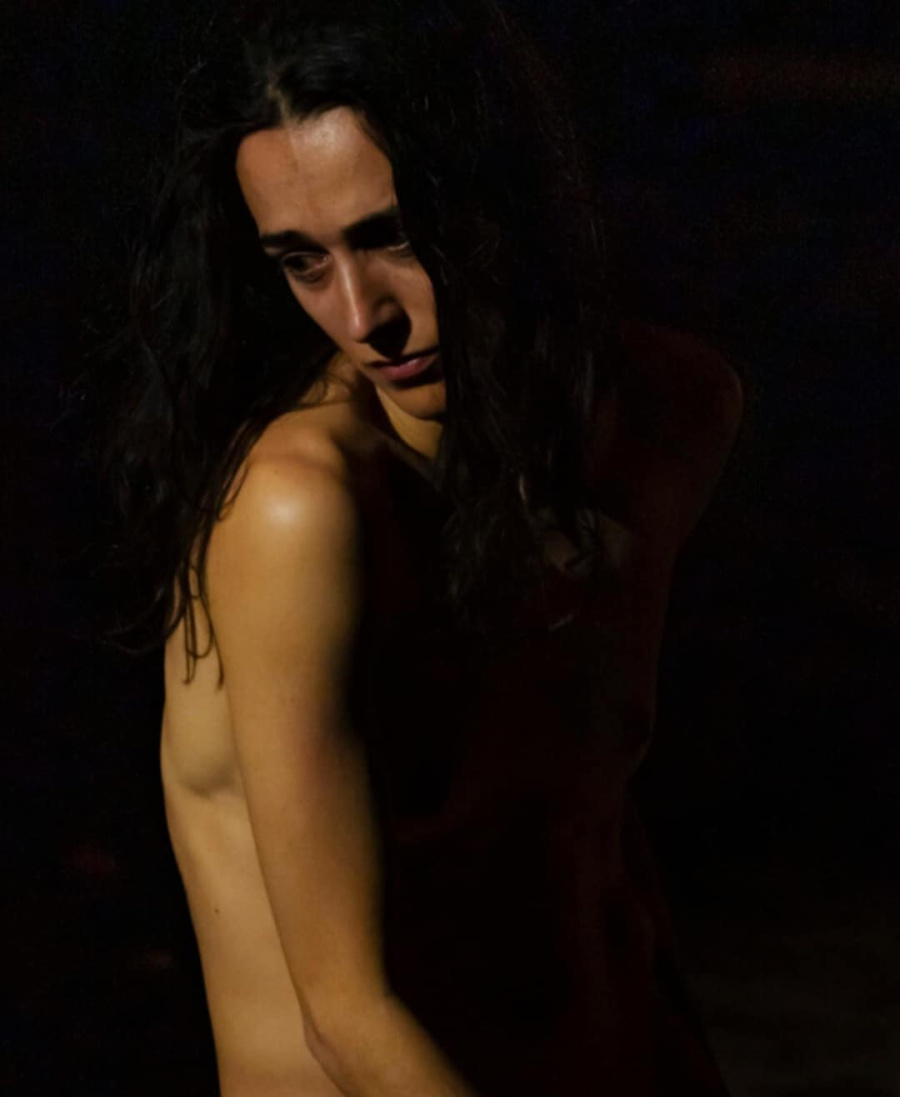
Eftychia Stefanou is currently participating in Mario Banoussi's new performance "Mami", which is being performed at the Athens State House of Letters and Arts. I met her and she spoke to us about this new experience, her collaboration with Mario through which she matures as an interpreter and the worlds she creates and of course the relationship between man and mother that never stops evolving..
Would you like to tell me how you experience the performance?
- Mami is one of the shows I really enjoy being on stage. As in all of Mario's works, I start filling the container of performance as soon as the skeleton of the role takes shape. From the rehearsals onwards, and with every pass, every performance, I am confronted with this girl I am embodying and her needs to express herself interpretively. This role is not static; it changes, deepens, reveals itself a little more each time. There are moments when I feel that I am not just performing, but experiencing something very personal.
This is your third collaboration with Mario. What is it like this time? Has something changed?
- I feel that I'm growing artistically through my collaboration with Mario. For me, this girl I embody in MAMI was already there in Lydita, where she was breaking down and experiencing grief. In the Tavern, she was the same figure, but this time she was experiencing absence, internalized anger, vertigo towards the empty chair, the shadow of the father figure. In MAMI, this woman continues her timeless journey through life. She is the one who falls in love, is thwarted, dives for solace, gives birth, sacrifices and is sacrificed. It is a path that has no clear beginning or end, a cycle that continues to evolve through each play.
Would you describe the way he directs and communicates with the actors as special?
- Mario has a unique way of connecting with his collaborators. He doesn't impose interpretive choices, but creates an environment in which relationships, emotions and situations emerge naturally. The way he guides us in rehearsal is almost imperceptible; it's as if things come up on their own, without being imposed. He creates atmospheres of intense emotional density and invites us to explore interpretive qualities and relationships. As a performer, I trust him completely, because he has proven that he can bring out the best qualities in his collaborators.
While the previous works are about death, now we have life and the relationship with the mother, would you like to comment on that?
- The themes we approach through Mario's work are always centered on the human being. Death, loss, absence, love, motherhood, love, love, frustration - all are parts of the human experience. Mami is not just a shift from death to life, but a continuation of the exploration of these themes from a different perspective. Motherhood, after all, is not only creation, but also dissolution, decay and conflict. It is life and death together.
How does the word "mom" resonate in your ears?
- The word mom comes to the lips as a necessity. I read somewhere that children who don't talk much do so because they feel they have what they need and don't feel the need to express themselves. When I said mom as a child, it was because I needed her: her presence, her hug, her look, her praise. If Mom was a place, it would be the sea - endless, present, full of flow. If she were a smell, it would be lavender - soft, yet strong, like something that stays on clothes forever. If it were taste, it would be sweet fingers of raw orange cake batter - something made with love and patience. If it were sound, it would be noise - a familiar noise that embraces me, that doesn't leave me alone in silence. A sound that, no matter how lost I get, will always answer to Mama.
Even as we are born and grow older, do you think the umbilical cord is ever cut?
- Birth is both a release and an amputation. Simone de Beauvoir's thoughts on motherhood resonate deeply with me. She describes pregnancy as a contradictory situation: a woman can feel pregnancy as enrichment, but at the same time as something that takes her over, limits her, transforms her into something she did not fully choose. Motherhood is not only giving and fulfilling; it can also be a field of conflict, even with ourselves. The body accommodates, but also resists. The embryo is a part of us, but also something foreign, an organism that grows inside us, that depends on us and at the same time dominates us. Society projects motherhood as a self-existent, harmonious state, as an absolute and balanced love. But it is not so for all of us. In Mami we touch on this very contradiction. We talk about motherhood beyond the romantic narrative, as an experience full of contradictions. As a condition that can be love, but also loss. As a presence that can be protection, but also containment. The umbilical cord is cut biologically, but the connection remains - sometimes as a strength, sometimes as a burden.